
30 Jan 2026
Asia-Pacific Stats Café Series: Death Registration: Updated Estimates, Gender Dynamics, and Country Perspectives
TAGS

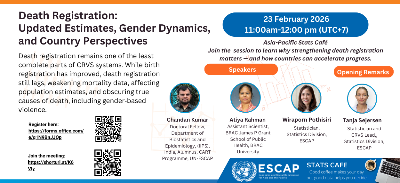
ESCAP will convene another session of the Asia‑Pacific Stats Café Series on 23 February 2026, featuring discussions on Death Registration: Updated Estimates, Gender Dynamics, and Country Perspectives, on 23 February 2026The event will unpack why death registration remains among the least complete components of civil registration and vital statistics systems worldwide, despite progress in birth registration. This session will bring together regional experts on death registration and showcase the latest estimates of death registration completeness in Asia and the Pacific, and country case studies from Bangladesh and India.


Date: Monday, 23 February 2026  

Time: 11.00 - 12:00 a.m., Bangkok time (UTC+7)

Venue: MS Teams

Event page: Asia-Pacific Stats Café Series
More News

30 January 2026

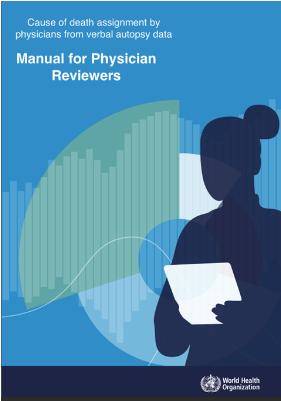
The World Health Organization (WHO) has released a technical manual for the assignment of causes of…

30 January 2026

After the pilot digital birth certificate programme in 2024 for people born in New South Wales,…

30 January 2026

Japan’s digital identity system reached a pivotal milestone as  Matsumoto Hisashi, Minister…

30 January 2026

Following the success of its soft launch for BruneiID App in November 2025, Ministry of Home…

30 January 2026

Our community newsletter puts a spotlight on people who have gone above and beyond in their efforts…

30 December 2025

Our community newsletter puts a spotlight on people who have gone above and beyond in their efforts…

30 December 2025

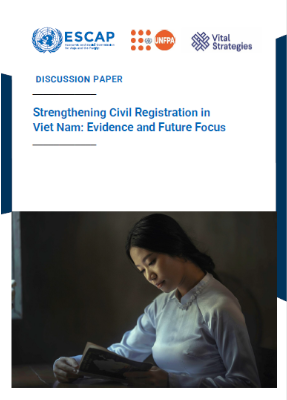
A new discussion paper by ESCAP, in collaboration with UNFPA and Vital Strategies, reviews the…

30 December 2025

Kazakhstan has reached a significant milestone in child rights protection, achieving an almost…

30 December 2025

Photo credit: UNFPA / Asad ZaidiAs the annual 16 Days of Activism against Gender-Based Violence (…

30 December 2025

In an increasingly digital world, incomplete birth records are emerging as a major barrier to…