
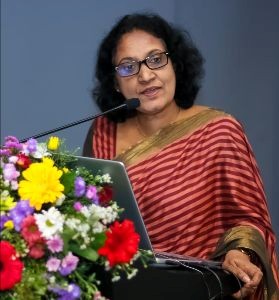
Our community newsletter puts a spotlight on people who have gone above and beyond in their efforts to support CRVS programmes in Asia and the Pacific, raise awareness of CRVS issues or lead CRVS improvement efforts in their home country or in the region. This month, we would like to dedicate this issue of Insight to Dr. Lakshmi Somatunga.
What is your current title and role?
I held the post of Additional Secretary (Public Health Services) in the Ministry of Health, Sri Lanka and retired in July 2025 after 25 years of service as a senior Medical Administrator out of my total period of 36 years of medical Profession. I continue to serve as a public health professional where my expertise is required.
Can you please share with us a particular experience which highlighted the importance of CRVS to you?
As the person overseeing both disease control and health promotion at the policy level in the health sector, it was of utmost importance that I recommend and take policy actions based on evidence. And the health sector has a greater responsibility to prevent all premature deaths and contribute to the sustainable development goals.
Therefore, CRVS improvement is a major subject area and a prioritized task under the Public Health Services because of the reason that the strengthened CRVS system is critical for effective governance, public health policy, and socio-economic development. Also, like many other public health subjects, CRVS has many stakeholders and goes beyond the boundaries of health but output of improved CRVS is essential for health sector to improve the health status of the nation by utilizing the data, derived from the CRVS system to yield impactful outcomes. Invariably, I had to lead the programme ensuring the participation and contribution by relevant stakeholders within and outside the health sector and to improve the CRVS situation and to steer the system towards progress.
How are you currently involved in CRVS improvements?
CRVS improvement in Sri Lanka was supported by Vital Strategies which was a great strength, and we were able to expedite many activities utilizing the opportunity. I performed as the Technical Head of the programme and when we commenced the programme, relatively good data coverage was present in the country but quality, timeliness and cooperation by all relevant stakeholders were not satisfactory. Therefore, taking the lead we, health sector invited main stakeholders, namely, Registrar General’s department, Department of Census & Statistics and Ministry of Justice to take part in working together. With everyone’s support and contribution, we were able to form a steering committee for Data for Health with several working committees under the main committee.
My guiding principle was assuring sustainability. Hence, all steps taken were within the system and capacity building was carried out at every step so that the institutionalization was ensured.
Starting with the health sector more emphasis was given to proper death declaration, and the intervention was started from the undergraduate education by developing a uniform curriculum for all the medical faculties with the support of the Ministry of Higher Education. The formats that have been used from last century to certify deaths for both institutional and community deaths were updated to capture proper death declaration as recommended by WHO. We have only one format left to be upgraded. A legal review of CRVS system of the country was done which is a milestone of CRVS improvement of Sri Lanka and not many countries of the world have carried out. Simultaneously, training of Medical Officers and Coroners (Inquirers into Sudden Deaths) was conducted. Monitoring vital statistics data and its usage was commenced and capacity building of district staff under the Registrar General’s Department is being carried out. Collaboration of all relevant stakeholders at the district level is being facilitated and continued technical support has been assured. The necessary instructions, guides and offline tools were developed and are being used for capacity building. And we are happy that our coordinated efforts led to the upliftment of our CRVS index of Sri Lanka to the next better level due to our dedicated teamwork for a decade since 2015.
Which advice would you give to others trying to improve CRVS systems?
First of all, a mechanism of collaboration with the participation by all relevant stakeholders at the national level should be established (e.g. CRVS advisory/ steering Committee or a task force). In order to give due attention to all the different components of CRVS, it is advisable to have working committees reporting to the national committee (e. g. MLDI, Digitalization/ one registry and monitoring etc.).
One sector should be taking the leading role, coordinating the collaboration. Most appropriate is the health sector with the leadership by Public Health component (Health sector is geared to chase targets like disease elimination and service coverage etc, therefore it is easy to lead the coordinated action).
Political commitment should be assured. Country level advocacy is essential. It should be mentioned here that the ministerial conference conducted by UNESCAP is highly effective in view of assuring political support and it should be continued.
A comprehensive review of the CRVS system should be carried out and a plan of action should be developed accordingly.