
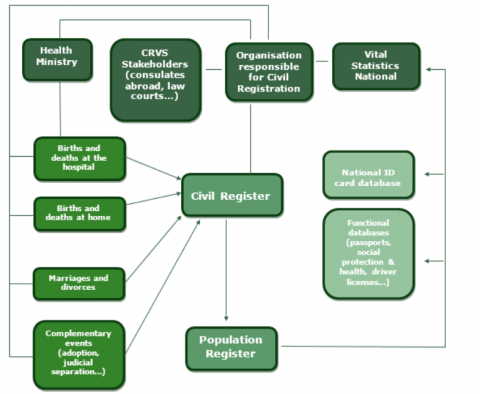
This workshop joins ESCAP's latest efforts to improve CRVS in the region by using an Enterprise Architecture approach on the existing Civil Registration and Vital Statistics processes. Together the countries and D4H developed country specific process models for the registration of 4 vital events (Birth Registration, Death registration and both events outside health facilities). The product of this work is particularly well aligned with 3 implementation steps of ESCAP's Regional Action Framework:
- The Comprehensive Assessment: As of May 5th only 29 countries had completed a CRVS Comprehensive Assessment and only another 7 planned to complete it. Process Modelling allows to see the complete process from beginning to end and provides a great opportunity to understand the current system, which will speed up a comprehensive assessment in the country.
- Establishing a coordination mechanism. Only 30 out of 62 countries have established a Coordination Mechanisms, which requires a proper identification of the action stakeholders play in the system. The D4H mapping facilitates the identification of stakeholders, their relevance and interest.
- National Strategy Development Plan, by identifying weak points and opportunities the Business Process Modelling, aids the strategic design process. This is a particularly difficult goal for the region, as only 15 out of 62 member states have achieved this benchmark. Some of the notable common weaknesses to be tackled in the national plans include:low death registration, lacking of cause of death, and coverage inequality.
This workshop took place from 9-11 May, 2016 at the United Nations Conference Center UNCC, Bangkok, Thailand and was organized by D4H with the collaboration of Melbourne University and the Swiss Tropical and Public Health Institute (Swiss TPH). Representatives from the countries with which D4H and its partners have been collaborating in the region (Bangladesh, Indonesia, Myanmar, Philippines, Solomon Is. and Sri Lanka), have worked together to define and improve their respective CRVS System Architectures. For this purpose the workshop applied specific analytical approaches to understand each country's system typology; organizational structure, processes and workflows. As explained by the Swiss TPH: “CRVS systems are extraordinarily complex systems; and much of the slow progress in CRVS performance improvements suggests system failures rather than technical failure”. This process allows for diagnosis of the system’s current architecture and modelling of the proposed architecture. This aids countries in planning better CRVS Systems and estimating the future requirements and resources needed to achieve them.